A tower of Babel
Both my parents worked in media, film and radio, and I was raised in what was essentially a tower of Babel. My first real job was assistant to Alexander Salkind on Superman. There we had Maria Monreal arranging things in Italian, the Swedish Stafan Ahrenberg looking over contracts, the American Omar Kaczmarczyk running sales, Hans Knall organising in German, Eyal Rimon on the phone to his girlfriend in Hebrew, Pierre Spengler talking to the United States in English and then taking Salkind's instructions in Russian, Salkind himself handling the bankers in German, and the rest of us communicating in French and English. I am leaving a few out. None of us found any of it odd. The others thought we were a travelling zoo.
My parents divorced when I was very small. My Russian grandmother lived in Nice, my mother went back to Austria, and my father, a film producer and a dedicated roulette player, changed apartments, hotels and cities with gusto. Occasionally the storage bill went unpaid, or he simply could not remember which city the storage was in. That actually happened, in London.
Schools, in five countries
We moved eight or ten times. I was passed between Spain, Italy, England, France and Austria, through different school systems in different languages, all of them united in a single purpose, which was to get me to leave as soon as possible. I was a real pest, though academically quite good. All my schools were thoroughly mixed: Europeans, Latin Americans, Africans, every creed and colour sitting next to each other in class. It did not occur to me that this was remarkable until I moved to America and encountered racism for the first time.
At ten I wrote a book on how to educate children. It came close to being published. I then lost the manuscript in a move, which tells you most of what you need to know about my childhood.
Mythology
From nine until my teens I read mythology obsessively, without noticing that I was absorbing something more useful than stories: the cultural and psychological profile of each civilisation that produced them. That turned out to be the single most practical education I ever received, and it has been quietly underwriting every script and every pitch since.
Selling the Salkind library
I had started with Salkind as an assistant. I ended up General Manager of Balfino AG, the sales organisation holding all media rights to Alexander Salkind's film library: Orson Welles's The Trial, Superman III, Supergirl. My job was to initiate, negotiate and close with buyers across every medium and every territory, on pre-sales as much as on finished pictures. I was directly and indirectly responsible for thirty-six million dollars of sales.
That is where I learned what a right is actually worth, which is not what the contract says it is worth but what the person in front of you can be persuaded it is worth.
Tokyo
I lived in Tokyo for five years as Representative Director of Atalanta Films Japan BV, and kept going back for another five. We processed, sold and distributed pictures into Japan for the major independents, Carolco among them, which is to say First Blood and Rambo, and we handled the contractual and financial follow-up that went with it. That meant working daily with the big Japanese entertainment companies, with Crédit Lyonnais, and with all five of the great trading houses. I learned to negotiate in a culture where the important part of the meeting happens before the meeting.
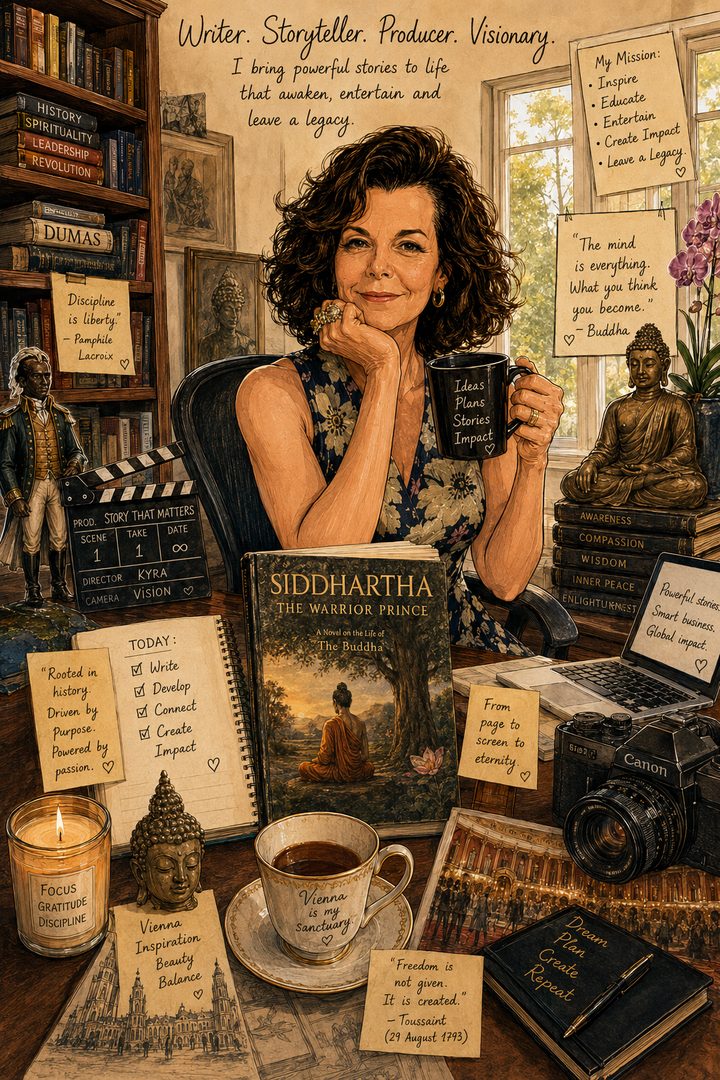
During that time I also wrote a script on the life of Siddhartha Gautama, based on the documents I could find and on the research of Professor André Bareau of the Collège de France. His life was largely a mystery, because lore recorded what he said but not what he did. I wanted to write who I imagined he was, and to explore what really happened in his time that made a man leave everything he knew in order to find answers to what he did not know, but felt had to be found out.
The project collapsed twice. First a backer withdrew. I sat on a small bridge in a Tokyo garden, watched the water go underneath, and concluded that if this was to be, well, it was to be. I would fight it in time, somehow, but for the moment I had to let it go. Then it came back and demanded to be finished, and collapsed again when Bertolucci announced Little Buddha.
So I stopped insisting on the script and wrote the book instead. It was published by Nil, Laffont and Pocket in France, by Espasa Calpe in Spain and by Bertelsmann in Germany, and it was the first literary novel on the life of the Buddha. The obstacles changed the goal and made me deliver more than I had planned to. I have found this to be the general rule.
What Germany would actually watch
TriStar Columbia hired me to build a social and psychological profile of Germany, and then to say what could be done with it. They had American sitcoms that worked more or less everywhere: Married with Children, Who's the Boss and a shelf of others. In Germany they were failing so comprehensively that people were practically throwing their televisions out of the window. This was a spectacle I was very eager to witness, and I was disappointed when every last television stayed indoors.
The instinct in that situation is to translate harder. That is the wrong instinct. The question was never what Germans failed to understand about those shows. It was what those shows failed to understand about Germans: what a German audience finds funny, what it finds rude, what strikes it as unbearably American, and what a family sitting on a sofa is supposed to look like in the first place. Then I had to say plainly which of it could be adapted and which of it could not.
This turned out to be the job I had been training for since I was nine, reading mythology and absorbing the psychological profile of each civilisation without noticing that I was doing it. Formats do not always travel. The thing underneath the format sometimes does, if you can identify which thing it is. I have been making that judgement ever since, in five languages, for films, for books, and eventually for a platform that had to work in a classroom in Lyon and a classroom in São Paulo on the same afternoon.
The fishing kolkhoz
Next, of all things, I went into partnership with a Japanese fishing company to obtain the rights to fish on Sakhalin. It was memorably cold. I remember standing on the bank of the Amur watching the ice float past and thinking that I really ought to be at the Cannes Film Festival. Instead I was working the local and federal authorities for fishing quotas, which in those years were worth their weight in gold.
We got them, by way of two rather clever moves that I am perfectly willing to describe to anyone who asks. What I could not fix was my partner. He had a temper, and he paraded his possessions in front of people who had nothing, which is an ugly thing to do anywhere and was fatal there. The Russians could not stand him, and the partnership became untenable.
The whole affair ran across the United States, Japan and Russia, lasted about two years and was a considerable adventure. It was also the CompuServe era, so sending an email meant a satellite link and hours of dialling to get a line at all. We travelled with a portable printer and the first Mac laptop and felt thoroughly modern. It was a strange time. The gangs had taken control of much of Russia's resources, fortunes were being made, and violence was everywhere.
The Archivum
Somewhere there is a vault holding nine videotapes, and I am the reason they are in it.
The idea was very simple and faintly scandalous, which is usually a good sign. People who have shaped a century spend their whole lives being edited, quoted in fragments and rewritten by others. The Archivum offered them twenty-five minutes alone with a camera: no interviewer, no journalist, no agenda. A message to posterity, sealed unseen, and broadcast worldwide within thirty-six hours of their death.
Nobody would watch it while they lived. Nobody could leak it, edit it or preview it. That last guarantee was the entire product. It is the one thing a head of state cannot buy anywhere else, and it is the reason people who have never in their lives spoken candidly agreed to speak candidly.
I founded it in 1998 and ran it as Chief Executive until 2004. Walter Cronkite and Pierre Salinger came in as senior advisers, which meant that the most trusted man in America was vouching for us before anyone had heard of us, and that John Kennedy's former press secretary was making the introductions. Jane Chaplin, daughter of Charlie Chaplin and Oona O'Neill, was a shareholder. The financial model was set up by the man who had been Chief Financial Officer of Castle Rock.
And then I had to go and ask people to talk about their own deaths.
Asking men like Gaddafi to record their last word was an interesting challenge.
You cannot soften the proposition, because softening it destroys it. The offer only works if you say the entire thing out loud, in one piece, and then sit still and let the person opposite you think. I got very good at sitting still.
What I learned is that they mostly say yes, and not for money. Money was explicitly secondary and everyone in the room knew it. They say yes because the alternative is being summarised by strangers, and because the chance to address the future directly, with nobody standing between you and it, is for a certain kind of person the last unclaimed prize there is.
By the time the business plan was written we had nine recordings in the vault: a Nobel peace laureate, a Secretary-General of the United Nations, a Prime Minister of France, two astronauts, an Academy Award winning actor, a Pulitzer historian, an American ambassador, and a presidential press secretary who had spent his career on the other side of the camera. Those nine I will not name, because not being named was the deal.
Beyond them was a longer list of people who agreed and then never sat down in front of the camera. Gerald Ford, Shimon Peres, Boutros Boutros-Ghali, Muammar Gaddafi and Adnan Khashoggi had all given their word or signed a letter. Yasser Arafat and Fidel Castro were still deciding. Not one of them ever recorded. We had to shut down: Salinger was too ill to carry on, and Betsy Cronkite was unwell, which took Cronkite out of reach. That brought down both of my generals at once. I have thought about it a great deal since.
The balance sheet was the strangest document I have ever put my name to: a company whose entire asset base was a shelf of sealed tapes, and whose value depended on the passage of time doing what the passage of time does.
Six years of my life went into it. The tapes are still there, still sealed, still unseen, which was the promise. One day a company will understand what is sitting in that vault and want to buy into it, and by then everything in it will be worth a great deal more than it was when I put it in.
The Archivum taught me the thing I have used everywhere since. Access problems are almost never really about access. They are about having something to offer that only you can offer, and then having the nerve not to flinch while you say it. Fishing quotas, publishing rights, comics licences, institutional partnerships: it is the same conversation in different rooms, and the nerve is the transferable part.
Hair accessories
Not everything follows a plan. I had just lost everything I had for the third time, and in 2003 I was sitting in New York with a friend, now gone, who introduced me to the owners of Scunci. They were intrigued by what somebody from my world could possibly bring to hair accessories, and hired me to find out.
I brought in a major player in international supermarket and retail distribution, and together we opened Europe, Asia and Brazil, with India on its way. It took 2003 and 2004. This suited the plan the owners had held all along, which was to sell to their principal competitor. They did, at a multiple, in no small part because there was now an international business to sell.
ZING Technologies
We all read Asterix as children, which remains the sole reason my generation retained its five words of Latin. I found out only recently that Asterix was created at the request of desperate teachers trying to get anyone to pay attention. Decades later I would build a company on exactly that principle, which I would like to claim was foresight.
All children love stories, and stories decide what people believe long afterwards.
Having been early to email, I then stopped paying attention for roughly a decade while everybody else acquired smartphones and apps. Then, back in Europe, somebody handed me an iPad and showed me what it could do. I looked at the static comics and imagined comics you could hear, in any language, and it did not occur to me to ask whether that was hard. This is my one genuine professional advantage: no concept of the impossible. Once I can picture a finished thing and live in it for a while, the question of whether it can be done simply does not come up, so I never learn what I am up against until afterwards.
I was introduced to a brilliant CTO who suffered my ignorance with the patience of a martyr, and the adventure started. Having been a writer, hired writers and sold rights, I knew how to talk to publishers, which turned out to be the genuinely difficult part. The licences came in. A financial partner joined, we raised what the app needed, and I watched a good many people visibly do arithmetic in their heads about who I was and what I was doing. It was, I have to say, entertaining.
Proving the point
As my grasp of the technology grew, so did the list of things it could obviously do next: training manuals, thematic comics, more than one subject taught at once. So I produced the graphic novel Crypto: L'argent du futur as a case study, purely to demonstrate that any subject at all can be taught this way. Then I set about convincing institutions, and here again not knowing what I was up against worked entirely in my favour, alongside a product I believed in completely. Both sides of that coin were necessary.
ZING Technologies came out of all of it. LingoZING teaches languages through comics, LegendHQ handles the entertainment side, and the Creator Studio turns any comic into a multilingual audiovisual title. Investors have included Mark Cuban and Eoghan McCabe. Partners and supporters have included Paris Saint-Germain, New York City Opera, NOMA Studios in Japan and the Éducation Nationale française. Stan Lee endorsed it, and I intend to keep mentioning that for as long as I live.
Now
Roughly every three to five years I take on a different challenge, which is either a philosophy or a diagnosis. At the moment the challenge is Toussaint Louverture, and it has my full attention.